My wife got me a book for Christmas in 2023 that sent me spiraling off in search of answers to a thousand different questions. Thanks, Amber! (Oh, yeah… You too, Rick.)
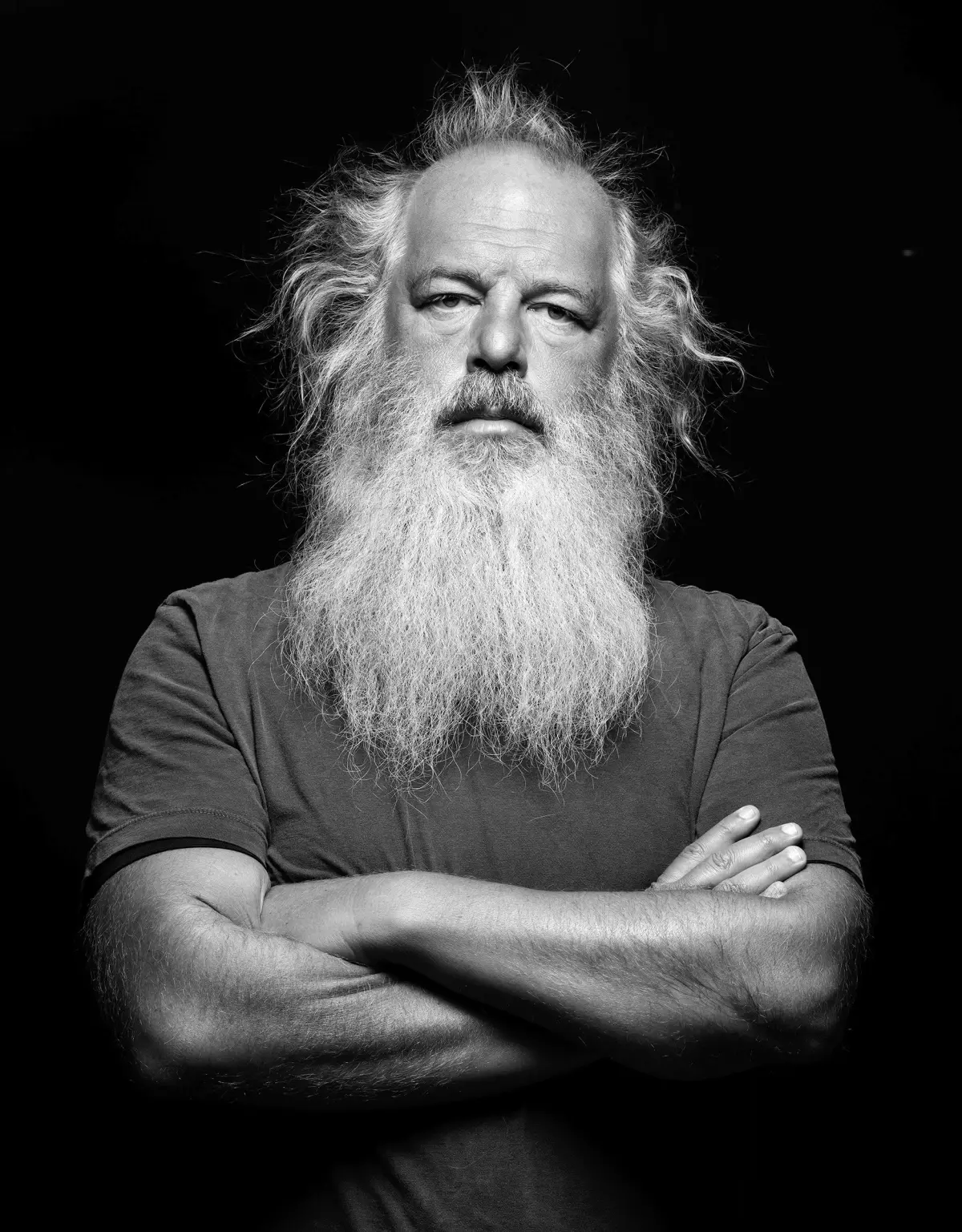
The other morning I sat down to read Making Contact: Preparing for The New Realities of Extraterrestrial Existence, which I recently checked out from my local library. But this post isn’t about that book. It’s kind of a meta analysis of the situation.
You see, the very fact that I was sitting down to read a book in the morning—and one about making contact with aliens, at that—is a direct result of the story I’m about to tell you.
Anyway, this book I’m reading. There’s a quote at the beginning that jumped off the page at me:
There is only one thing more powerful than all the armies in the world, and that is an idea whose time has come.
—Victor Hugo
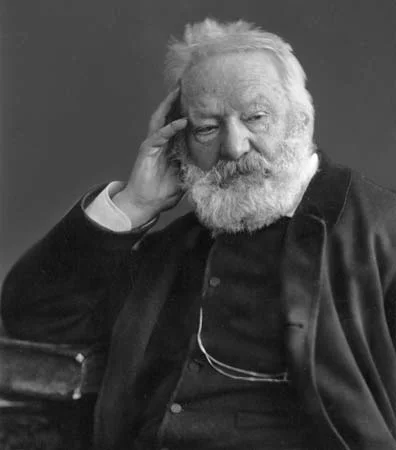
Whoa. An idea… more powerful than all the armies in the world? That’s a bold statement. But it makes sense. An idea can be taken on by just about anyone. And there are more civilians than armed forces in the world—so in a literal sense, if a certain epoch contains within its zeitgeist an idea that gains mass adoption, no amount of armed pushback will be victorious in the end… in theory, at least.
This is a wonderful quote, but it brought me full circle: about a year ago is when I, unwittingly, began my “spiritual journey” in earnest. The catalyst? A book I received for Christmas from my wife. It’s called The Creative Act: A Way of Being by Rick Rubin.
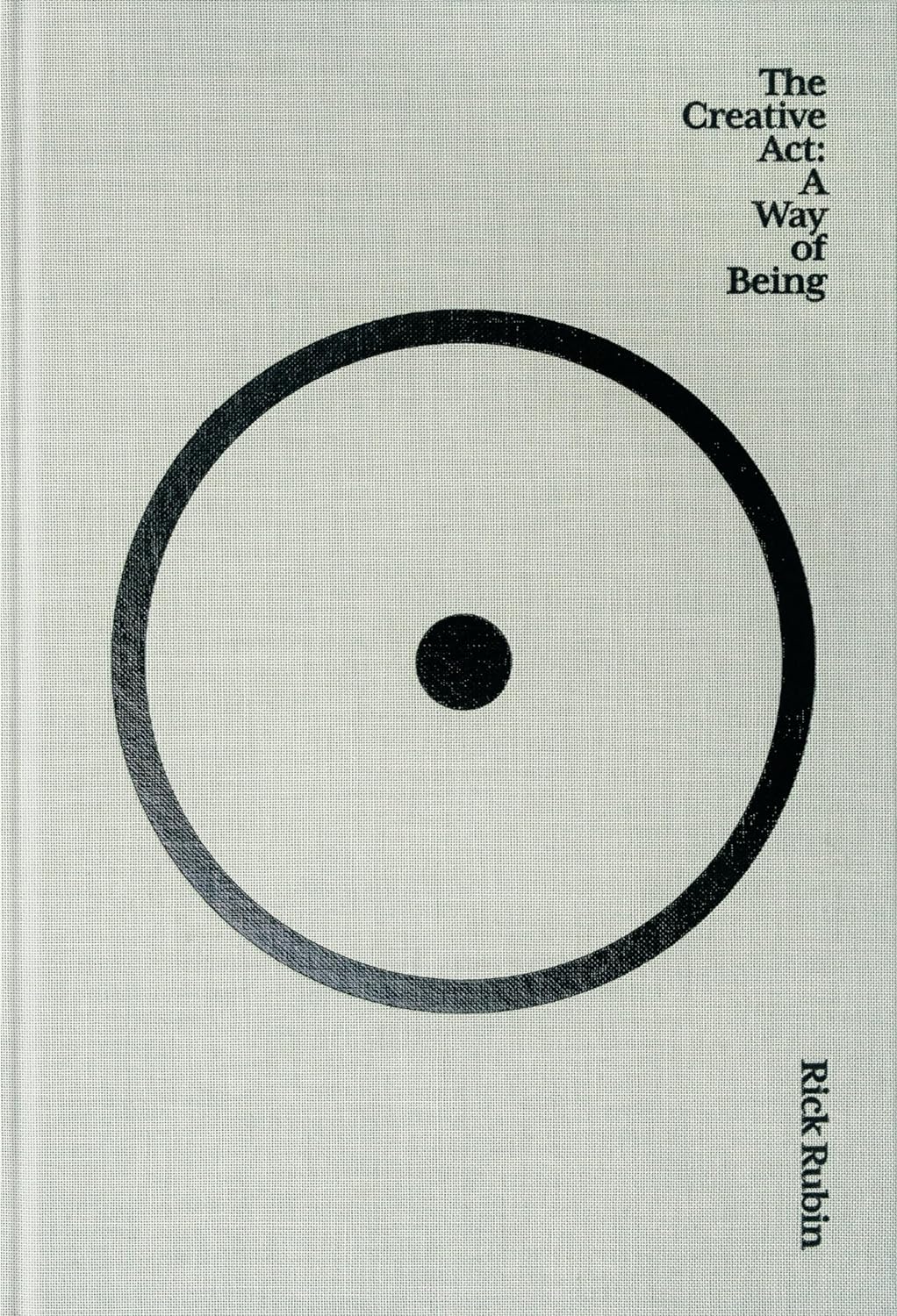
Funny I use the phrase “full circle” since this book’s cover is adorned with an actual full circle with a dot in the middle. This is called a circumpunct or circled dot. It’s rich with significance throughout history.
According to Jung, the circumpunct neatly represents the ego (the dot in the middle) in relation to your greater self (the larger circle surrounding the dot). Pythagoreans saw it as a symbol of the monad—the totality of all things, or the absolute (a concept I was introduced to during my journey down the Gateway Tapes rabbit hole, which I’ll get into in more detail in a later post).
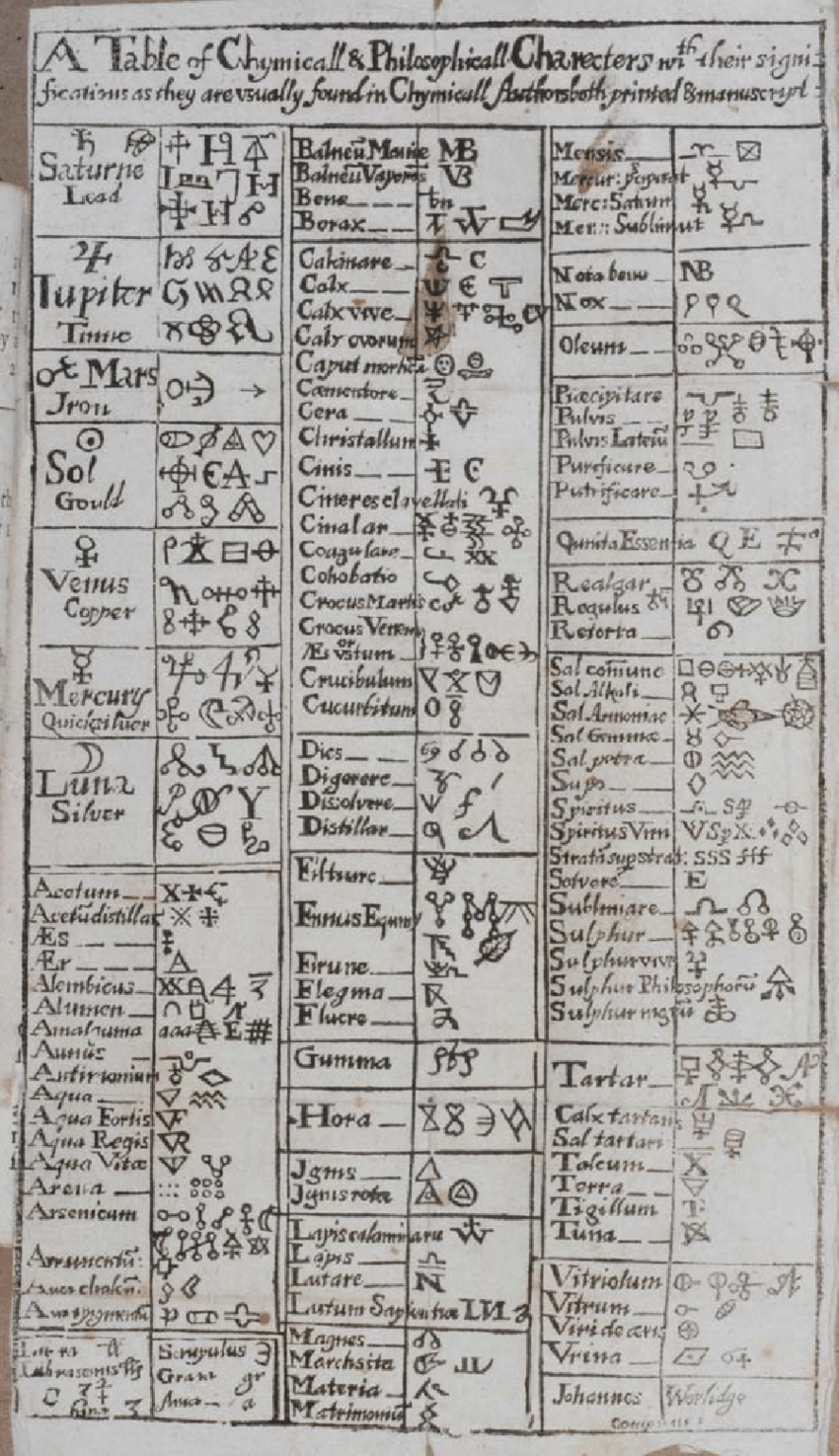
If you take a look at the chart above, you’ll see that the circumpunct also represented gold in alchemical symbology. Various alchemical symbols were associated with planets from our solar system; our sun (Sol) is associated with the symbol for gold. Unsurprisingly, this symbol is also said to have been used when describing Ra, the sun god of ancient Egyptian mythology.
Ra played a big role in my spiritual journey this year—I read the first book of the Ra Material books and have started the second of five. I’ve started discussing the books and the Law of One they describe on the podcast; I’ve linked the most recent episode below if you missed it (or are a recent subscriber to Behold The Spirit).
Why The Book Spoke to Me
Rubin’s book is, in a sense, meat-and-potatoes. There’s no florid, impressive language as you’d get from an academic or an author of “literary” fiction who’s trying to drive home the point, in between the lines of what they’re actually saying, that they’re super smart and profound.
He writes clearly with little room for misinterpretation. You get what he’s saying easily; the real work happens once you’ve taken the message onboard and allowed it to sit in your subconscious for a while. His tone and manner of speaking mirror the style of some Buddhist writing I’ve encountered previously, maybe Zen koans, though without the paradox.
It reminded me that I love to read
It’s important for me to note, too, that I was a lapsed English major when I received this book. I couldn’t tell you the last time I’d sat down to just… read a book, much less when I’d last finished one. I was in a world of web development articles and online courses and side projects; in my mind, I simply had no time for reading. I did enough reading throughout the day, anyway.
Receiving Rubin’s book when I did helped unlock something in me that I didn’t know I needed. It’s almost like it gave me a sort of permission to step away from the computer and read the written word on paper, just like I’d done countless times before. I was a bookworm as a kid; this book revealed to me that that part of me never died, it just went into hibernation.
78 areas of thought
I should also call out that, while I will call them chapters for the sake of convenience, Rubin doesn’t see them as such: he labels them as 78 areas of thought. This was one of the most appealing things to me at a high level when I first approached the book. I am a sucker for a good, bite-sized chapter. I can’t stand walking away in the middle of a chapter, and many books just don’t make it easy to tell where you’re able to safely walk away.
Rubin is concise and to the point in every aspect of this book. It’s easy to pick up and equally easy to put down when you need to.
Democratized Creativity
Rubin sees creativity in much the way John Cage viewed music: if interpreted a certain way, anything could be considered music.
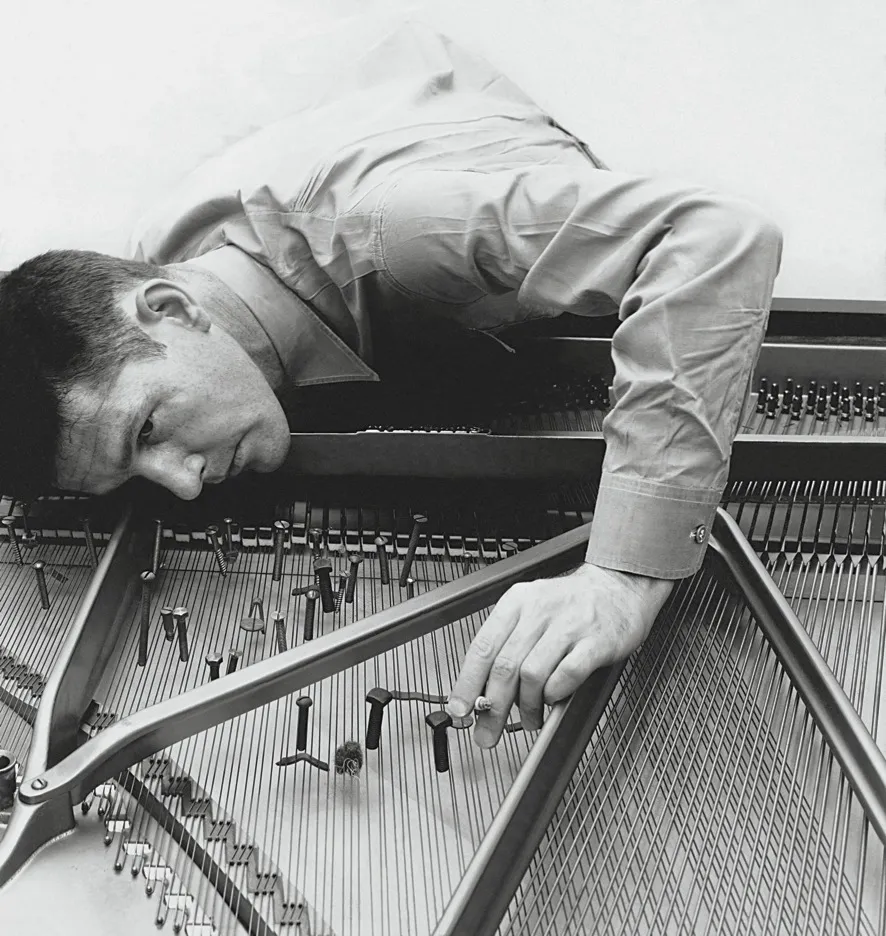
Side note: I wrote another post with an essay comparing the left-leaning values of John Cage against the right-leaning values of Milton Babbitt, one of Cage’s peers. You can read that here:
Rubin similarly sees all of us as creators in our own rights, perhaps often just unconscious of our own capacities for the act of creation: “[B]y the mere fact of being alive, we are active participants in the ongoing process of creation.”
He wastes no time bringing you deep into the middle of his worldview: on page 2, he drops this paragraph on you:
In each moment, we are immersed in a field of undifferentiated matter from which our senses gather bits of information. The outside universe we perceive doesn’t exist as such. Through a series of electrical and chemical reactions, we generate a reality internally. We create forests and oceans, warmth and cold. We read words, hear voices, and form interpretations. Then, in an instant, we produce a response. All of this in a world of our own creation.
Damn, dude. I came here to learn how to, like, write better songs, not to pull on a thread that would unravel my entire model of reality. But that’s what started happening—a kind of creative destruction.
Eyedea: Close Your Eyes and Open Your Mind
Almost as soon as I’d started the book, I knew I was in for a thought-provoking experience. That description of undifferentiated matter—it sparked something in me, a familiarity or a recognition. I quickly made the connection: this was the type of metaphysical (well, technically physical bordering on the meta) content that made me fall in love with the writing of the late Micheal Larsen, better known to fans by his stage name, Eyedea (and often teamed up with his good friend Max Keltgen, otherwise known as DJ Abilities, to form the duo Eyedea & Abilities).
Eyedea was a rapper—but, to quote him, it was “much more than just your average rapper’s words.” He talked about his thoughts and feelings in a vulnerable way that some might be tempted to label as “emo” simply for the fact that it is vulnerable, but it went deeper than that. He really seemed to be in touch with his spirit and knew the place of his ego in relation. Much of his writing explored consciousness, the “I am” and its relation to reality—and one of the best examples is from a track called “Powdered Water Too” where he ruminates about the sea of signals in which we swim in each moment:
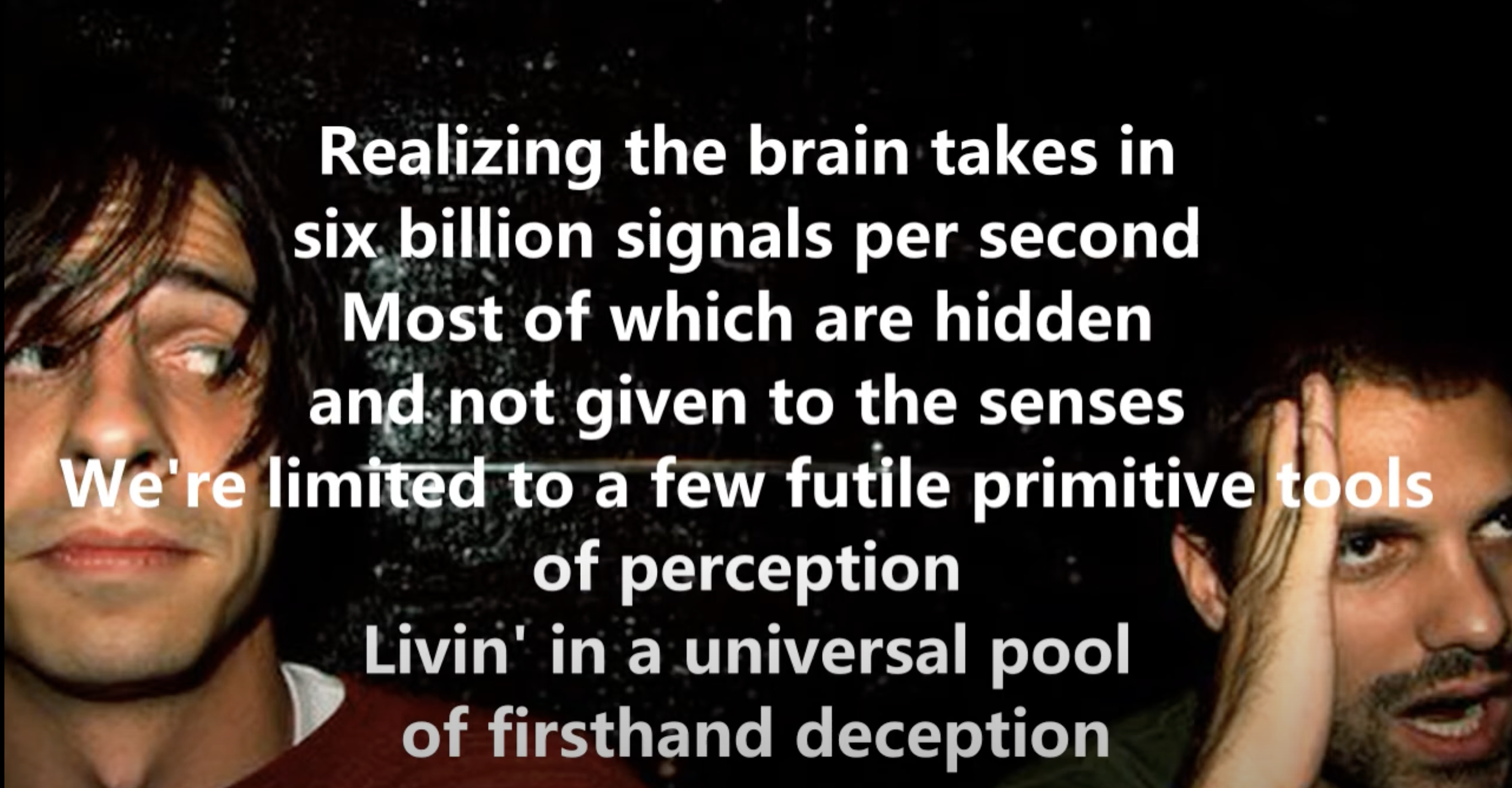
As a teenager, this was one of my early introductions to how our brains interfaced with reality and the implications of our filtering mechanisms—in other words, how much detail we were taking in but simply not processing or registering because we weren’t primed or imprinted to recognize those patterns. And it made me wonder how, for example, psychedelic experiences were possible; something to do with altering the big biocomputer that is the human brain. Or, as I’ve learned since then from Aldous Huxley, perhaps psychedelics simply clean the “doors of perception” that our senses represent.
Watch the lyric video I grabbed the screenshot above from here:
I’d internalized this understanding of the interconnectedness of everything at a young age and hadn’t quite been conscious of it. Seeing Rick Rubin say basically the same thing from a different point of view reawakened that thought in me. I wasn’t caught off guard by the novelty of the thought, just that it’s something I hadn’t thought about in… probably years. Rubin was stirring up the thoughts that had settled to the bottom of my mind in a big way… and I hadn’t even made it past the first chapter.
Perhaps This Book’s Time for Me Had Come
Let me bring it back around to beginning before I meander off too far. In the second chapter (or area of thought) called “Tuning In,” Rubin says:
[The clocklike rhythms of the universe] are not set by us. We are all participating in a larger creative act we are not conducting. We are being conducted. The artist is on a cosmic timetable, just like all of nature.
If you have an idea you’re excited about and you don’t bring it to life, it’s not uncommon for the idea to find its voice through another maker. This isn’t because the other artist stole your idea, but because the idea’s time has come.
In this great unfolding, ideas and thoughts, themes and songs and other works of art exist in the aether and ripen on schedule, ready to find expression in the physical world.
In this interpretation, artists don’t “create” new ideas, but act more as the conduits through which the ideas may come into expression. Often, when artists are said to be “ahead of their time,” it’s because they channeled an idea whose time simply had not yet arrived.
I don’t think an idea’s time arrives only for the “creative types” and artists of the world. I think cultural zeitgeists—the “spirits of the times” which loosely define the “vibe” and headspace of someone living in a given place at a given time—often collectively embrace the arrival of ideas who seem to have shown up at just the right time.
As we stand on the precipice of the most hardcore authoritarian rule the United States has ever embraced (at least openly, and within its own borders), and as countries around the world join in the rising tide of fascism, I only hope that it’s not too late for humanity to wake up and reflect upon what we’re truly doing to ourselves.
No matter how disappointed I might be in my fellow man, or how angry some of these spiritually blind fools can cause me to be, I still find it hard not to love and wish better for us all. Perhaps fascism’s time has come for us so that we may learn a hard, horrific lesson we wouldn’t be able to learn otherwise. That’s the most silver lining I think I can muster.
Anyway, great book… I still need to finish it
The unfortunate thing about books that are as overwhelmingly inspiring and thought-provoking as this one is that it tends to inspire the attention-deficit among us to put it down and go look up more information about something you just read. Hopefully you don’t recurse into another rabbit hole from there (or, perhaps, hopefully you do; life seems to be much more about the detours for me lately).
If you’re looking for a new book, especially one that will inspire you, I can firmly recommend this one. It sent me on a whole journey—one that continues to this day.
Leave a Reply